It is that time of year. My favorite pthalate free fragrance supplier,Candlescience, is having its spring scent sale. I have to place the order for my spring scents today. I have some shows to do and would like your input on what scents should be added to my line this spring. Here are the choices. I will take all the people who comment and randomly draw a name from a hat. That person will get a free bar of soap. They get to pick the scent :)
1)Basil and Herb
2)Beach Linen
3)Black Raspberry Vanilla
4)Coconut
5)Coconut Lime
6)Coconut Lime Verbena
7)Citrus Basil
8)Cucumber Melon
9)Day at the Spa
10)Dreamsicle
11)English Garden
12)Fruit Slices
13)Gardenia
14)Golden Rose
15)Green Tea and Lemongrass
16)Bamboo
17)Jamaica Me Crazy
18)Lavender Cucumber Sage
19)Lavender Vanilla
20)Mango Tangerine
21)Love Spell
22)Peach
23)Peppermint Eucalyptus
24)Pineapple Coconut
25)Pineapple Sage
26)Pink Sugar
27)Plumberry
28)Plumeria
29)Sweet Pea and vanilla
30)Tuscan Melon and Vanilla
31)White Tea and Berries
32)Strawberry
Let me know what sounds good to you. I need at least 5 new scents:) If something sounds like it would be awesome in a candle, but maybe not in soap, I would like to know that too. Thanks.

Showing posts with label handcrafted soap. Show all posts
Showing posts with label handcrafted soap. Show all posts
Tuesday, March 12, 2013


Friday, April 23, 2010
How to Make Cold Processed Soap
Making your own homemade soap is not only providing your family with a great natural product, but it is also really addictive. I love making soap. The only thing I love more is teaching other people how to make soap for themselves. So I am going to try and teach you how to make a very basic soap. It is really simple.
**Always wear disposable gloves to protect your hands, sodium hydroxide is dangerous.
**Keep vinegar around to neutralize the sodium hydroxide (lye)
Step 1
Measure your water and lye accurately.
Step 2 Mix the lye into the water, carefully. This solution will get very hot and will burn you badly if it gets on your skin. Use the vinegar if you spill on yourself..
 Step 3 Measure you solid oils, (coconut oil, shortening, palm oil, shea butter, etc.) and melt in stainless steel pan over low heat. Remove from heat when barely melted.
Step 4 Measure liquid oils, (olive, sweet almond, castor, apricot kernal, etc. ) and mix with melted solid oils.
Step 5 Allow all oils and sodium hydroxide (lye) solution to reach the same (100 degrees) temperature.

 Step 6 Mix the lye solution into the oils. Stir with stainless steel wisk or stick blender until soap reaches trace, (trace is when the soap becomes a pudding like consistency) You will know that it has traced when a drizzle over the surface will set on top of the soap and not sink down inside. Add any additives ( fragrance, herbs, etc.)
Step 7 Pour soap into a prepared mold ( anything will do, I have used pvc, a new kitty litter box, disposable rubbermade containers, soap molds, wooden molds). If you use a plastic type mold make sure you spray it with Pam. If you use wood make sure you line it with waxed paper, a white garbage bag, or butcher paper.

Step 8 Place a cover over the soap and insulate with a warm blanket. If you use wood it usually does not need to be insulated.
 Step 9 You can unmold in 24 hours.
Step 10 Cut into bars and allow to cure for 4-6 weeks.

Step 11 Enjoy great natural soap that you made yourself.
High Grade Sodium Hydroxide Lye Micro Beads, 2 Lbs. (Buy 5 get $15 off)
GARDEN BUG SOAP BARS Animal Soap Mold

LARGE LOAF Miscellaneous Candy Mold Chocolate
**Always wear disposable gloves to protect your hands, sodium hydroxide is dangerous.
**Keep vinegar around to neutralize the sodium hydroxide (lye)
Step 1
Measure your water and lye accurately.
Step 2 Mix the lye into the water, carefully. This solution will get very hot and will burn you badly if it gets on your skin. Use the vinegar if you spill on yourself..

Step 4 Measure liquid oils, (olive, sweet almond, castor, apricot kernal, etc. ) and mix with melted solid oils.
Step 5 Allow all oils and sodium hydroxide (lye) solution to reach the same (100 degrees) temperature.

 Step 6 Mix the lye solution into the oils. Stir with stainless steel wisk or stick blender until soap reaches trace, (trace is when the soap becomes a pudding like consistency) You will know that it has traced when a drizzle over the surface will set on top of the soap and not sink down inside. Add any additives ( fragrance, herbs, etc.)
Step 7 Pour soap into a prepared mold ( anything will do, I have used pvc, a new kitty litter box, disposable rubbermade containers, soap molds, wooden molds). If you use a plastic type mold make sure you spray it with Pam. If you use wood make sure you line it with waxed paper, a white garbage bag, or butcher paper.

Step 8 Place a cover over the soap and insulate with a warm blanket. If you use wood it usually does not need to be insulated.
 Step 9 You can unmold in 24 hours.
Step 10 Cut into bars and allow to cure for 4-6 weeks.

Step 11 Enjoy great natural soap that you made yourself.
High Grade Sodium Hydroxide Lye Micro Beads, 2 Lbs. (Buy 5 get $15 off)
GARDEN BUG SOAP BARS Animal Soap Mold
LARGE LOAF Miscellaneous Candy Mold Chocolate
Wednesday, March 31, 2010
Vanilla Swirl Handmade Soap
I was so inspired by my cucumber soap experience that I decided to try swirling my next batch of vanilla. I used the same recipe as the cucumber melon soap. I replaced the cucumber melon fragrance with vanilla and omitted the cucumber puree. I removed half of the soap at light trace and added the vanilla fragrance (which turns dark brown in cold process soap) to the remaining half of the soap. I poured the fragranced soap in the mold and then drizzled the unfragranced soap over it in a zigzag. Then I just left it alone to set up.


I think it turned out beautiful, and the vanilla is awesome!
Basic Soap Making: All the Skills and Tools You Need to Get Started (Basics)
High Grade Sodium Hydroxide Lye Micro Beads, 2 Lbs.
Soaper's Delight Organic Coconut Oil, 1 Gallon buckets

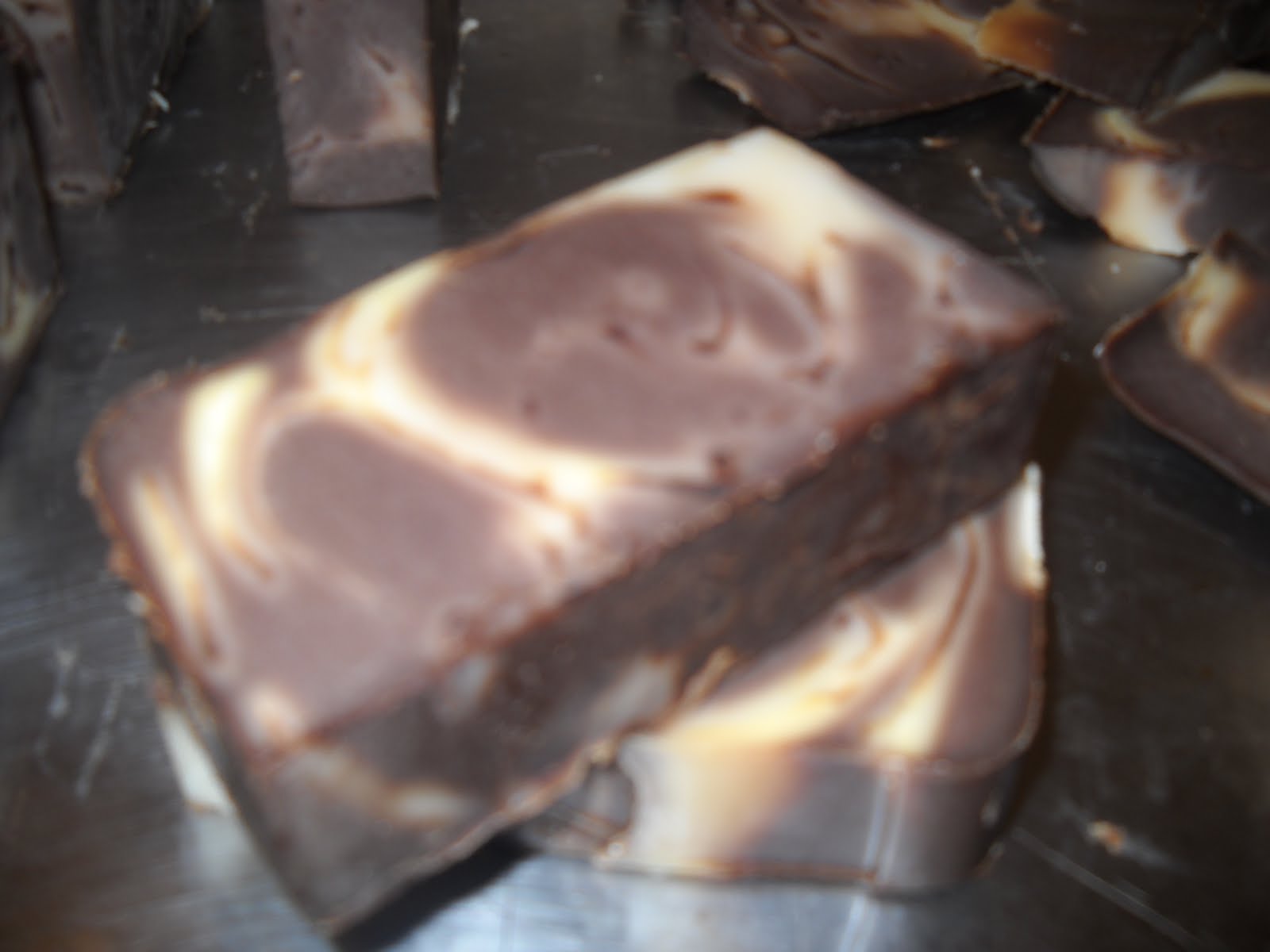
I think it turned out beautiful, and the vanilla is awesome!
Basic Soap Making: All the Skills and Tools You Need to Get Started (Basics)
High Grade Sodium Hydroxide Lye Micro Beads, 2 Lbs.
Soaper's Delight Organic Coconut Oil, 1 Gallon buckets
My Green Cucumber Melon Handmade Soap Turned Out Awesome!
I am very grateful that my green Cucumber Melon Handmade Soap didn't turn out quite as bright as it was when I made it.
After 24 hours I unmolded it. It is a nice pale green, and smells yummy too.
I can't wait for it to get done curing.


Tuesday, May 5, 2009
Soapmaking 101-The Different Types of Handmade Soaps
The 4 basic types of soap that you can make at home:
Melt & Pour
Re-batched or Milled Soap
Cold Process
Hot Process
Melt & Pour
This type of soap is ussually bought pre-made into large blocks. It is often clear and made out of glycerine, though it can contain many other things as well.
This is ussually considered the easiest form of soapmaking because you simply melt the block down , add any scents, colors , or herbs that you choose and pour into a mold. When it is hard it can be unmolded and is ready to use. The ease of use with melt and pout allows you to make rather intricate and beautiful works of art out of your soap.
Re-Batching or Milled Soap
This is ussually a cold processed soap that is made into "noodles", melted, and remolded. This method is slightly difficult, but produces a harder bar of soap as well as a truer scent and color in the final product.
Cold-Processed
This is by far my favorite type of soapmaking. It is how I started and it just seems so simple and elegant to me.
In order to make soap with this method you must measure and mix accurately . The mixture of oils and the mixture of lye and water need to be mixed at the right temperature. At this point saponification starts to occur and the soap and oil mixture will "trace" or become pudding like. It is then molded and insulated and saponification continues to occur. In 24 hours you can ussually unmold and soon after cut into bars. This product then needs to cure for4- 6 weeks or so to complete the saponification process, become hard and no longer have any lye in the bars of soap.
Hot processed
Hot processed soap is made similarly to cold processed soap, except that it is actually cooked during the saponification process. This reduces or eliminated the need for the product to cure after mixing, however, it also seems a bit more dangerous to me. With so many little ones around my house, its really not something I want to try. If you do choose to try it Ive heard that you can use the oven to do this rather successfully.
Dont Forget to check out all of our soapmaking ingredients at www.avalonsoapworks.com
and check back here often for recipes, tips, and instructions on how to make great handmade items yourself!!
Melt & Pour
Re-batched or Milled Soap
Cold Process
Hot Process
Melt & Pour
This type of soap is ussually bought pre-made into large blocks. It is often clear and made out of glycerine, though it can contain many other things as well.
This is ussually considered the easiest form of soapmaking because you simply melt the block down , add any scents, colors , or herbs that you choose and pour into a mold. When it is hard it can be unmolded and is ready to use. The ease of use with melt and pout allows you to make rather intricate and beautiful works of art out of your soap.
Re-Batching or Milled Soap
This is ussually a cold processed soap that is made into "noodles", melted, and remolded. This method is slightly difficult, but produces a harder bar of soap as well as a truer scent and color in the final product.
Cold-Processed
This is by far my favorite type of soapmaking. It is how I started and it just seems so simple and elegant to me.
In order to make soap with this method you must measure and mix accurately . The mixture of oils and the mixture of lye and water need to be mixed at the right temperature. At this point saponification starts to occur and the soap and oil mixture will "trace" or become pudding like. It is then molded and insulated and saponification continues to occur. In 24 hours you can ussually unmold and soon after cut into bars. This product then needs to cure for4- 6 weeks or so to complete the saponification process, become hard and no longer have any lye in the bars of soap.
Hot processed
Hot processed soap is made similarly to cold processed soap, except that it is actually cooked during the saponification process. This reduces or eliminated the need for the product to cure after mixing, however, it also seems a bit more dangerous to me. With so many little ones around my house, its really not something I want to try. If you do choose to try it Ive heard that you can use the oven to do this rather successfully.
Dont Forget to check out all of our soapmaking ingredients at www.avalonsoapworks.com
and check back here often for recipes, tips, and instructions on how to make great handmade items yourself!!
Subscribe to:
Posts (Atom)